Tuesday, 19 January 2021

Brutalism on the Budapest Metro - A photojournal

Descent to the Soviet underground- Deák Ferenc tér station on Metro Line 3. (All photos 4th September 2017).

Beneath the streets of modern Budapest, the capital of Hungary and ninth largest city in the European Union, lay a portal to the past. While the city has proudly swept away most of the remains of its communist past it seems one piece of its infrastructure was forgotten, the beating artery that is Metro Line 3.

The original terminus of the line at Nagyvárad tér, before extension south to Kőbánya–Kispest in 1980.

Tourists seeking the communist experience may be directed to the 'Momento' park where many of the statues from the era now lie, but beneath their feet the brutalist designs of 1970's Hungary were displayed to thousands of commuters every day. 

Waiting for a ride at Klinikák station.

Opened in 1976, line 3 became something of the 'ugly' sister of the network in recent years. The famed line 1 features in all the tourist brochures with its claim to be continental Europe's oldest underground railway (the London Underground is older). While the slightly older line 2 (opened in 1970) received a major upgrade in the early 2000's with refurbished stations and brand new trains. When it came to line 3 the funds simply did not exist, and so, the route remained captive in its 1970's timewarp.

Each of the stations features differences to the bold schemes and designs used - Deák Ferenc tér features mirror lined columns and rows of square housed fluorescent tubes.

The rolling stock used on the M3 dates from the lines inauguration in 1976 and is very much of a Russian design. The original stock consists of E-series (Ev3) units built by Metrovagonmash in Saint Petersburg. Additional trains of the upgraded 81-717/81-714 design, with modified cabs, were added to the roster from 1980 as the line was extended. These trains are workhorses of so many Soviet metro systems and can be seen across the former eastern block but unlike many of their post-USSR deployments the Budapest sets stayed true to their identity and retained their original blue colour scheme, displayed in many faded shades. The interiors of the trains have seen many variations; some vehicles still retaining the attractive and antiquated filament lights. While most cars wear a calming mint-green there are also cars with white or wood effect interiors, such is the longevity and variety of the stock.

 
Klinikák station with the old train displays, counting down to the next departure. The striking red columns make this stop difficult to miss.


One of the more imposing stations, in my view at least is Nagyvárad tér where the station consists of a double height atrium. The trains run along either side of a large concourse in the centre. On the mezzanine level walkways exist above where the tracks lie and further escalators lead up to street level. Historic pictures of the metro attempt to give some purpose to this space which seems to offer little else other than a place to sit facing the wall. Bright plastic seats are a feature of this urban underworld with various designs adapted to suit the individual decor of its stations.

My photography session at Nagyvárad tér draws to a close as the staff member in blue is about to tell me that photography is not permitted. Fortunately the memories of this space are already recorded on my camera.

Long absent from the London Underground following the tragic fire of 1987 at Kings Cross, wooden escalators still have a charm and can be found at many locations around the Budapest Metro. Passengers descend the clunking steps to the platforms at Ferenciek tere.

Primary colours and plastic benches at Klinikák station as another metro draws to a halt.

Closing doors and mirrored columns - Ferenciek tere.

Nagyvárad tér sees another blue train arrive, the polished metal numbers  giving the cars a sense of style. 

If these pictures have inspired you to take a better look underground on your next trip to Budapest then I am sorry to say that you are too late. As early as 2006 the Budapest city Mayor was warned that M3 was in dire need of investment to maintain its service- it took just over another decade for any investment to filter through. By 2016 a contract had been signed for refurbishment of the rolling stock (the price of brand new metro trains, as had been provided for M2 was not able to be justified) by the original manufacturer, Metrovagonmash. The rolling stock was to be extensively upgraded with new cabs, new electrical equipment, interiors and of course a re-paint. The first of the white refurbished sets returned in March 2017 and by the time of my visit the few 'new' trains were merely an inconvenience to dodge for photographs.

Fluorescent reflections (and a pigeon), for there is no natural light in the depths of Határ út station. 

Worse was to come for affectionados of the brutalist architecture of the system- during 2017 the first contracts were signed for the total refurbishment of the stations and upgrading of the line. The new look is bright and modern and will be fully accessible by the time that the final stations are completed in 2021. The major upgrade was undoubtedly long overdue and has caused considerable strain for the users of M3 with large sections of the route as well as sets of stations closed for prolonged periods for the upgrade work to continue. The investment will have dragged M3 into the modern era and provided Budapest with a mass transit line fit for the twenty first century. 

Many angles at Határ út as another metro arrives. This is the last underground station before the line emerges into the daylight to terminate at Kőbánya-Kispest. Undoubtedly the refurbished stations will be far brighter.

Riding the escalators at Deák Ferenc tér - the Budapest metro features particularly deep lines, built during the cold war and able to double up as shelters - thankfully carrying passengers has remained their only use. 

Monday, 4 January 2021

Island Line Class 483 Farewell

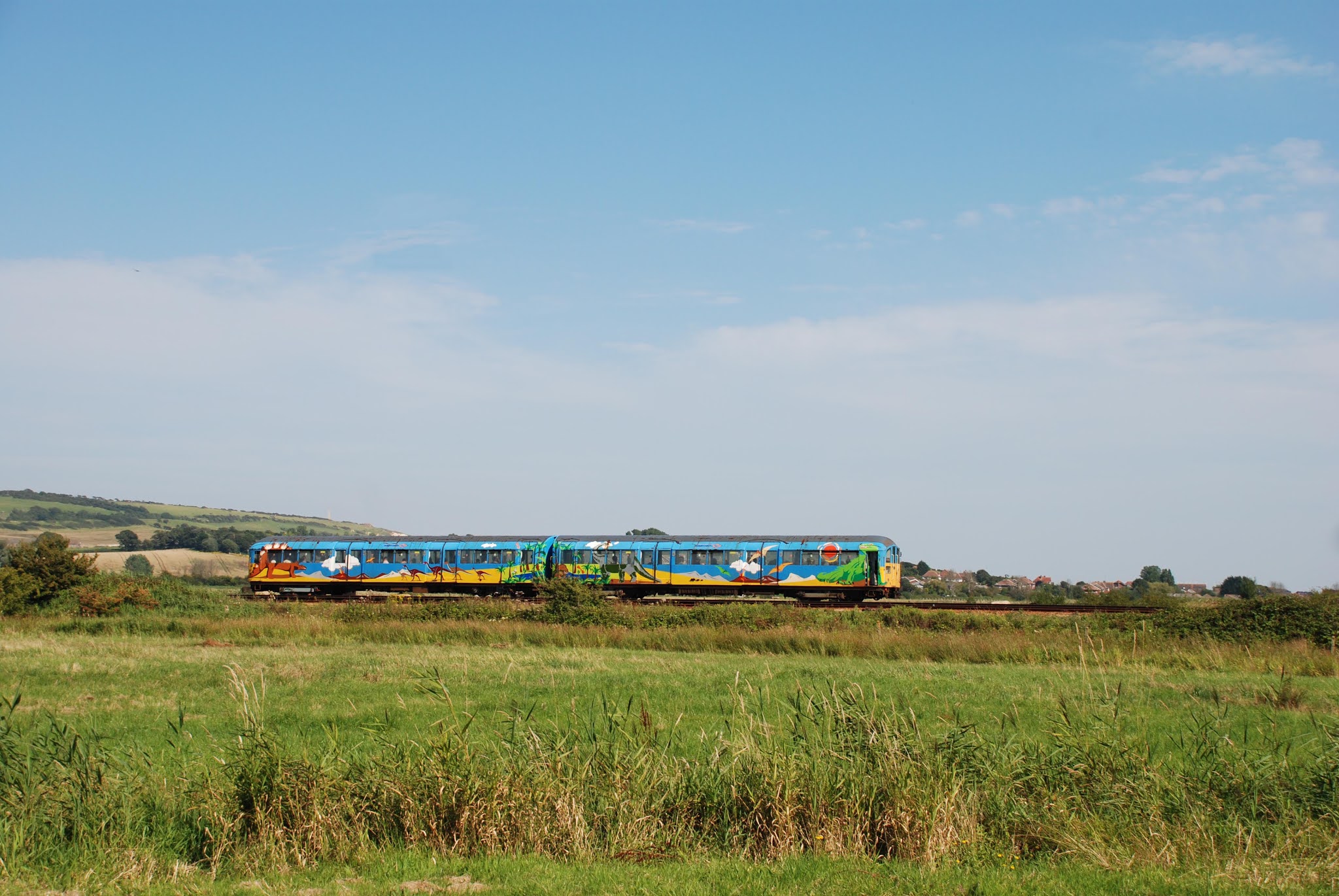
From left to right 006, 004 and 002 all wearing the rather garish 'Dinosaur' livery stand outside Ryde St Johns depot on 1 August 2007.

009 is seen south of Brading on 1 August 2007.

I have had a connection with the Isle of Wight all of my life, my mum's side of the family having originated there and with my grandparents living in Ryde throughout my childhood and teenage years. This meant wonderful summer holidays on the Island exploring its myriad of tourist attractions, beaches and, of course its railways. 

The house on the Island was a stone's throw from the sandy beach of Ryde, and that also meant it was just a few minutes walk from the railway. Some of the first trains I would have come across in my childhood would have been the ex-1938 tube stock which worked the Island Line, designated class 483. 

002 trails a 4 car formation lead by 006 which is about to plunge into Ryde Tunnel. The train is just at the point where a younger me would be standing on top of the tunnel waving to the driver and hoping for a toot on the whistle in return. The line to the left has been out of use for a number of years leaving just a single track serviceable up the pier. 2nd August 2003. 
In the final months on 18th October 2020, 006 is about to
depart from Ryde Pier Head to Shanklin. 

I distinctly remember standing on the top of the tunnel at Ryde waving to the drivers of Network South East liveried tubes as they plunged into the tunnel- more often than not receiving a toot on the whistle from the driver as they did. 

More than any other town on the Island, the railway is an intrinsic part of Ryde. You can see and hear the train rumbling up the 681m pier from the Esplanade to meet the boats and watch the trains from the beach and as you are going about your shopping in Union Street.


008 is Ryde bound as it passes the popular photo spot in Los Altos park, Lake on 1st August 2007.

A smart looking 009 approaches Sandown on
1st August 2007.
Class 483 operation on the Isle of Wight commenced in October 1989, shortly before my 1st birthday. It goes without saying that I do not remember the 1923 'Standard' VEC/TIS stock which preceded it. The trains were formed of driving motor coaches of former London Underground 1938 stock, already 50 years old when it arrived on the Island. It had been refurbished for Network South East and delivered to the Island to run on the 8 1/2 mile line between Ryde Pier Head and Shanklin, the last remaining part of what had once been a sprawling network covering some 55 1/2 route miles serving all four corners of the island. 


006 arrives at Lake station from Shanklin on 3rd November 2020.


006 still wears NSE moquette when it was
photographed internally on 19th Sept 2004.
Despite regularly seeing the trains it was some years before I actually remember being able to ride one, our family holidays always involved driving and taking the car ferry, and thus the train did not feature in our travel plans. It was when I was a little older and allowed out myself that I first remember using the Island Line, by which time all of the trains had been repainted into the, shall we say 'questionable' Dinosaur livery to celebrate the Islands claim as the Jurassic Island after a number of dinosaur fossil finds. It is a regret to this day that I was never able to photograph the trains in their NSE that I remember them wearing so well. 


006 heads towards Brading on 3rd November 2020. I had unusually chosen to drive to the Island on this occasion, in a large part due to expecting just a one train, hourly service due to the other unit 008 being unavailable until the afternoon. Having the car did allow me to take a pole to give just a little extra height.

008 emerges from Ryde Tunnel and approaches the
Esplanade on 1st August 2007. The bridge remains a popular 
spot to watch both trains and the Islands unique hovercraft.
By my mid teens I was no longer relying on persuading Grandma that we should visit somewhere by train as I was allowed out on my own- and by now I had a camera. Much use was made of an Island Day Ranger ticket offering outstanding value (especially on a child fare) for a day out on both the electric trains on the Island Line and the steam trains on the beautifully restored Isle of Wight Steam Railway. 
It was 2003 when a little more interest was sparked- somehow escaping the 'Dinosaur' scheme which had bestowed the rest of the fleet, 007 was outshopped from the works at Ryde St John's Road in a version of its original London Transport red livery, complete with lettering. It looked great and it was probably this unit that persuaded me to get out and record the line with my camera.
 

The original London Transport liveried unit, 007 is pictured entering Ryde St Johns Road station looking ex-works during its first summer in traffic in the heritage colours, complete with lettering which was never replicated on further units. 2nd August 2003.

008 is viewed near Brading on 1st August 2007.
Soon after a second unit, 009, was outshopped in red, though it never gained the lettering of 007. This enabled a 4 car formation to be run combining the two units- the regular service pattern at the time requiring three units for traffic providing a two car and four car unit for the 20/40 minute interval service. 
By this time the original fleet of 9 trains (a tenth was provided as a source of spares) had been reduced to 6 working examples; 003 and 005 had been withdrawn and quickly scrapped while 001 spent several more years in the headshunt at Ryde St Johns as a source of spares. 
The remaining fleet of 002, 004, 006, 007, 008 and 009 would become the trains I would get to know over the next 17 years as I spent time photographing the line and enjoying my days out on the old electrics. In time the 'Dinosaur' units also lost their livery to give a uniform fleet of LT red trains, though no others ever did receive the 'London Transport' decals originally applied to 007. 

006 is about to head up the pier from Ryde Esplanade on 28th May 2006.

Ex-works 006 arrives into Ryde Esplanade on
28th November 2017 bound for Ryde Pier Head.
As time went on my links to the Island reduced as family moved, or passed away and my summer sojourns became far less frequent, not least as I now had my own agenda to follow. I still liked to visit though to travel on the unique railways of the Isle of Wight and relive my wonderful childhood summers. Those visits, along with a few specifically to photograph the 38' stock in its final year have produced many of the pictures I have displayed here spanning 18 years of the class 483's. 


007 + 009 work together on 21st September 2013.
Originally a stand alone franchise upon privatisation in 1996, 'Island Line Trains' was operated by Stagecoach, which was then incorporated into their much larger 'South West Trains' network upon the renewal of the franchise in 2007. The trains and stations were spruced up to reflect their heritages status, but other than that very little changed on the Island Line despite the advancing age of the stock. 
By 2017 when South Western Railway took the reigns of the franchise it was clear that the future of the islands railway had to be discussed- the trains were now 79 years old, the oldest fleet in mainline service in the UK and the infrastructure was in need of repair. 

Seventeen years since the previous picture, 006 passes through Los Altos park bound for Lake on 3rd November 2020. The train has changed colour and the vegetation on the fence has grown up now making the shot difficult without the aid of a pole (which was used here). 

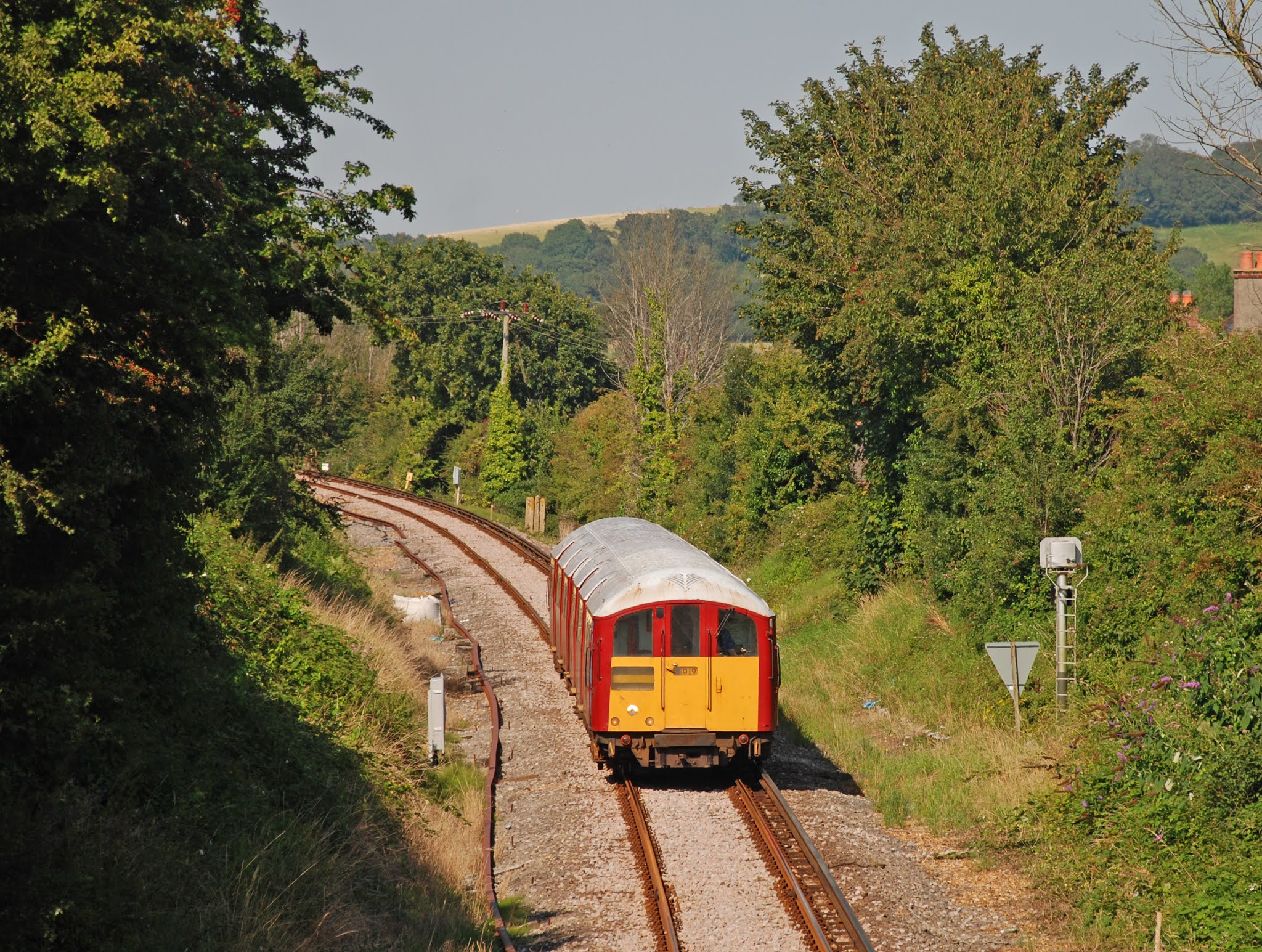
006 emerges from the trees south of Brading on 3rd November 2020.
The consultation into the future of the railway considered several options, some rather unfavorable to continued operations of the line in its present state, including options to convert the route into a tramway, however ultimately the winning one retained a heavy rail service over the Island Line which would be upgraded and receive replacement stock as part of a £26 million investment. Continuing the tradition of recycling ex-London Underground units the line would receive stock from the 'D-Train' family, former sub-surface stock from the District line which would be re-built by VivaRail. Finally the writing was on the wall for the venerable class 483. 

007, under overhaul and 008 in for general maintenance at Ryde St Johns Road depot on 29th May 2019.


A four car formation formed of 006 + 002 is seen departing 
 Smallbrook Junction on 2nd August 2003. Unit 007 can be 
seen in the distance waiting to enter the single line towards 
Brading.
The upgrade couldn't come soon enough- the 38' stock was by now really showing its age and availability was at an all time low with repairs being ever more difficult to execute, in large due to the inability to obtain spare parts. By the beginning of 2020 the fleet was down to just two serviceable examples, 006 and 008 providing all services with 007 on a prolonged overhaul; the three year timescale again due to issues obtaining parts. The days of four car trains had finished several years before and now it was becoming common for services to be reduced to just an hourly service with a single unit if one of the trains required repairs or an exam. By the end of the year the growing struggle of keeping the 483's going was really showing and on more than a few occasions the line was reduced to no service at all with rail replacement buses being provided - fortunately the Coronavirus meant that this did not affect as many passengers as normal. 

Autumn colours are in evidence on 3rd November 2020 as 006 is seen between Lake and Shanklin.

009 leads a 4 car formation into Smallbrook Junction on
28 April 2014 on the occasion of a UK Railtours 'Ticket to 
Ryde' excursion which brought many enthusiasts to the Island. 
The final day of class 483 operation was set for the 3rd January 2021 after which the line would close for 3 months to allow for upgrade works, including the long term goal of reinstating the loop at Brading to allow a regular 30 minute service. 
The service over Christmas had been sporadic, though did feature the highlight of 007 returning freshly overhauled for the final weeks of 38' stock operations. Unfortunately Covid-19 restrictions have made it impossible for the units to receive the send-off that they really deserve and ultimately the service on the final weekend was much reduced.

Having entered traffic just for the afternoon following an exam, 008 is pictured at Ryde St Johns at twilight headed for Sandown on 18th October 2020.

006 approaches Lake on 3rd November 2020.

When the line re-opens in April the class 483's will be no more, replaced by the Vivarail Class 484, derived from ex-District Line D78 stock - itself already more than 40 years of age. Five two car units have been ordered to provide the 30 minute service and will bring a step change in terms of passenger comfort, access and information. 

It is understood that several of the remaining class 483's will be preserved; 007 is thought to be heading the short distance to the Isle of Wight Steam Railway while a second unit, expected to be 006 or 008 is expected to head to the Epping Ongar railway in Essex, itself a former London Underground branchline.
006 heads down Ryde Pier on 16th September 2020. The unique spectacle of the railway running along the pier is paramount to its existence, providing the connection to the passenger ferry to Portsmouth.

Monday, 28 December 2020

All Paced out- a final farewell to the railbus.

My introduction to the pacer, a class 142 in Reginal Railways colours stands atop the impressive viaduct at Knaresborough on 1st June 1999, taken by my dad. While it may not look it I am sure that I was fairly excited by both the pacer and my ice cream!

142055 in the gloomy depths of Manchester Victoria station
on 29th November 2008. This version of Merseyrail livery was
the closest I would see to my yellow Tyne & Wear model.
It was on a family holiday to Harrogate in Yorkshire that I first recall encountering a 'Pacer'. These railbuses regularly worked on the Harrogate loop and several would have been taken on that trip as we travelled between York, Harrogate and Leeds. I remember particularly enjoying our day out in Knaresborough, and more to the point, enjoying the railway there with its quaint stone station, semaphore signals, signalbox, manually operated crossing and attractive viaduct. It was quite a scene compared to the busy electrified commuter line into Waterloo that I was used to. The trains running were class 142 'pacers', something I recognised instantly as just a couple of years previously I had received Hornby's (1995/96) 'Twin Train Set' for Christmas with a class 47, and a yellow Tyne & Wear 142. Obviously living in the south I had never seen one until now.

Knaresborough again on 1st June 1999, this time with a three 
car class 144 in the original WYPTE livery.
You could say that on that day I developed a bit of an affection both for Knaresborough, and for the humble 'Pacer', the train which so many loathed but which I found characterful and just very different from the trains I was used to back home. It always felt something of a treat to ride them with their rudimentary bus seats, distinctive 'click clack' over jointed track, and of course the fact that simply being in pacer land meant I was far from home on an adventure. 

My first few years of taking a real interest in the railways, both on holidays with my family (who fortunately seemed accommodating with my requests to make the occasional holiday as some sort of pilgrimage by train) and my first few solo trips enabled me to see a good number of old BR liveries, which lasted well into the 2000's as well as many of the early privatisation liveries. 

One of the early privatisation livery was the bold colours of Northern Spirit, seen here on 142065 at York waiting to form a service to Leeds on 28th October 2004.

One of my very earliest railway photos, 142001, now preserved
as part of the National Collection is seen at Preston on 21st
February 2002. This was the only time I recall seeing a
unit in the grey red and white livery of Greater Manchester PTE.


The pacer was developed as a short term solution to replace aging and asbestos ridden 1st generation DMU's which were coming to the end of their lives in the 1970's. The fusion of a high-tech BREL 4-wheeled chassis with a relatively cheap body from the Leyland bus company, based on it's modular 'National' bus design showed promise for winning overseas orders, however despite several prototypes and many trials the UK was to prove the only customer. The first production design was the class 141, used by West Yorkshire PTE from 1984 - 2005 and were a class that I would never see in service. Two units are preserved while many of the 20-strong fleet finished their working lives in Iran of all places, ultimately the only Pacers to actually be sold to a foreign customer! 
Pacers on the English Riviera- 143611 works an Exmouth to Paignton service along the sea wall at Teignmouth on 5th May 2018. When new a batch of 142's were allocated to Devon and Cornwall but later transferred north when they proved unsuitable due to excessive track wear on the branches. A number of Pacers became based at Bristol and Exeter in more recent years, the GWR examples probably being the last units to receive a re-paint to spend their years in the new green livery.


143604 pauses at Cardiff Central with an evening service to
 Barry Island on 3rd December 2005.
The first real mainstream design of Pacer, and, in my opinion at least, the most iconic was the class 142  which was built to a wider body design to capitalise on the larger rail loading gauge compared to a bus vehicle. 92 of these Leyland / BREL build units were delivered starting in 1985 to various local transport executives. 

The final base design of railbus was the class 143 and 144. The class 143 was built by Hunslet-Barclay with a body provided by rival bus-builder Walter Alexander which went into competition with the Leyland design while the class 144 relied on a BREl chassis. The 2 car 143 went into operation in the north before transferring to Wales and the Westcountry while the 144 with both 2 and 3 car variants spent its life working around Yorkshire.

There are many resources which tell the full detailed history of the development of the Pacer railbuses and for those interested in the subject I recommend Eric Woodcock's informative story. 

When I travelled on 144021 on 2nd June 2004 it was running as a hybrid with a refurbished center car between two original condition driving coaches - a direct comparison therefore being able to be formed between the original 'bus' style seats and the undoubtedly more comfortable high back seats which were replacing them at this time.  

The exterior of the above unit showing the
non-refurbished driving coach again at
Knaresborough 02.06.04
As the preservation era continued Pacers were refurbished and re-painted in many guises across the areas in which they worked. All of the class 143 and 144's, as well as the vast majority of the 142's received new high backed seats to replace the original 'bus' style seats. This was a step change in comfort though I was always still pleased when one of the untouched originals turned up with the bus bench seats, some of which lasted right until the end. 

There were three main areas to see the Pacers in action in their latter years; right across the North of England operating for Northern Rail, with particular centers of activity around Leeds, Manchester, Sheffield and Newcastle. With Transport for Wales centered around Cardiff for use on the Welsh Valleys, and finally a small consignment with Great Western Railway based around Exeter (and previously also Bristol for First Great Western).

Another area where class 37's brought me into contact with Pacers was the Rhymney valley line in South Wales where loco hauled trains ran alongside the diminutive railbuses for many years. 143605 is seen in 'Valley Lines' livery approaching Ystrad Mynach with a service from Penarth to Bargoed on 27th August 2005.
A small number of ex-First North Western 142's spent a brief period
based at Exeter for South Devon workings. One such example,
142009 is seen at journeys end on 2nd June 2010 at Paignton.
By the 2000's when I was taking an interest the Pacers, built with a planned design life of 20 years, the units should have been well on their way to replacement. However there was neither the money or desire to replace such a large fleet of trains working on subsidised routes and the fleets changed operator, and livery several times during privatisation, mostly sticking to their traditional routes in South Wales, Yorkshire and the North East. 

By this time these quick fix trains were widely loathed by the passengers which used them regularly and promises were made by franchisees to look into their replacement with the Northern franchise in 2014 specifying the trains replacement as a condition. It was expected that widespread electrification would eliminate many of the trains, and render investment by ROSCO's into new diesel trains unviable, however when the money and schedules for these works slipped it was finally recognised that new trains were urgently needed. 

A surprise return to loco-haulage on the Rhymney line in 2019 brought me back to the South Wales Valleys where the pacers were also still plying their trade. Now with decals promoting their iminent withdrawal 142009 climbs up to Pontlottyn with a classmate on the 19th August.

143604 leads a 142 to Penarth from Cardiff Queen St on 6th
July 2018. Now working for Transport for Wales the units 
finished their lives wearing the livery of Arriva Trains Wales.
The final death-nail for the pacers was undoubtedly the disability discrimination act of 1995 which was to be fully adopted by the railways by the end of 2019. Trains would all have to be fully compliant and therefore accessible- something which the pacers were not. Despite the radical refurbishment of 144012 to prove compliance could be achieved, the days of the pacer were coming to an end. 

Delays in new stock gave the units what should have been a final stay of execution into early 2020, with derogations permitting pacers to continue running when coupled to other compliant units with final withdrawal of the 144 fleet expected before May. Then Covid 19 came along and space became a premium. Extra capacity was needed to allow for social distancing and the pacer was an obvious solution, the extra two coaches of a class 142 could be coupled to a compliant train to help passengers keep their space through the height of the pandemic.
The Pacers, and especially the 142's will always be known best for their services across the North of England. Now in the colours of Northern Rail, 142025 is captured just before sundown at Brough on the 28th November 2016 while working from Hull to York.

142021 attracts the attention of a fellow photographer at
Doncaster as it approaches its original withdrawal date. The
unit is working an Adwick service on 6th December 2019.
Not even the virus could keep the pacer running forever, and in late 2020 the last pacers are now terminating their final journeys. 
27th November saw the final pacer working for Northern, while GWR also ran their final class 143 in early December. The final Welsh class 142's will be withdrawn before 31st December when their derogation expires, however it appears the final active members of the class will now be the class 143's operating around Cardiff for Transport for Wales with a last minute extension of their derogation until the end of May 2021.
I, for one, will be sad to see them go. 

Many units have already been preserved, including 142001 for the National Collection. Heritage railways hope that the train that is hailed as the saviour of rural railways can also help to provide a cost effective option to allow more services to be run- only time will tell how leisure travellers will respond to being offered the 'worst train in Britain' as their heritage experience!

Back where my pacer adventure began, now on a digital camera and with me behind it, a class 144 in the attractive WYTPE scheme is shunting on Knaresborough viaduct 02.06.04 having arrived with a service from Leeds. After an early start from York I had picked up a sausage roll from the local bakery and was pleased to catch the pacer as a warm up shot while waiting the passage of the class 37's which worked a daily commuter turn from Knaresborough to Leeds for Arriva Trains Northern before continuing over the Settle & Carlisle railway.