|
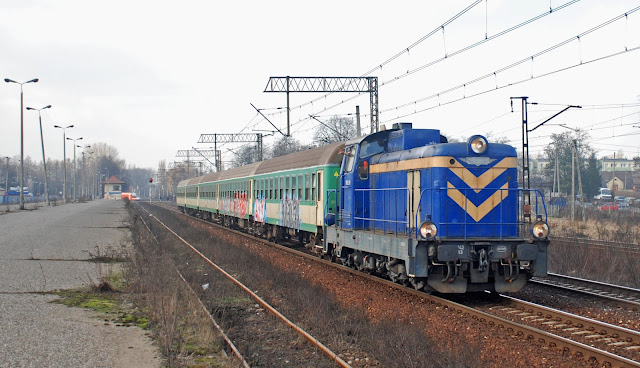
A typical polish scene as EN57-1170 calls at Krakow Łobzów.
More than 1400 of these EMU's were produced over a period
of 32 years from 1962-93 making them the longest produced
EMU in the world. 09.02.2011 |
A number of PKP passenger trains were seen here, mostly in the hands of
the EU/EP-07 passenger locos as well as some ECS workings to and from the main
station. We also saw a handful of freights, the highlight being Green ET41 pair
ET41-156 on a coal working, these locos effectively being the double unit of
the EU07 (and most likely the first proper 'double unit' locomotive I had ever
seen.
With a successful morning behind us we then boarded a train to the
industrial town of Trzebinia.
I remember Trzebinia being
possibly the grottiest industrial town I had thus visited- but it was a great
railway location with frequent freight and passenger trains. We quickly became
distracted by a train which was shunting in the roads to the side of the
station- it was formed of a number of coal hoppers top and tailed by a NZTK
loco numbered S200-260 (my first sighting of the ChME3 family) and a very
colourful TEM2-185 from PTK Holdings SA Zabeze - this one also made a nice bit
of noise and smoke!
 |
NZTK
S200-260 of the ChME3 family shunts at Trzebinia. 09.02.2011
|
 |
PTK Holding TEM2-185 brightens up (and blackens the skies) at Trezibnia while running around its coal train. 09.02.2011
|
 |
SM42-609
passes through the station at Trzebinia, these locos
being pretty ubiquitous across Poland. To the right an
independent snowplough can be seen in blue. 09.02.2011 |
We were also lucky to catch sight of PKP ET21-386 which arrived light
engine. At the time these locos, dating from 1957 were on the brink of
extinction with the national operator though we did understand those that were
left tended to operate in the mountainous south. We had one more stop today at
Jarwozno Szczakowa, reached on an EN47, however by the time we reached the
station the light was fading. The nearby hump yard was busy and several SM31's
were working here- I class I had not seen but was not able to photograph
properly from the station. We had a nose around the depot which included
photographing a few more ET41's- we didn't want to delve too far in the dark
however and happy with our haul for the day we returned by Kraków hauled by one
of the very likeable green ET22 locomotives which were hired to Przewozy
Regionalne at the time.
 |
At
the end of its career ET21-386 parks up at Trzebinia- this would be the only
example I would see in service with PKP. Completing the scene is an ET22 hauled
coal train. 09.02.2011
|
Day 3 - 10th Feburary 2011:
 |
ET22-606
has passed under the signal box and slows to call at Gliwice with a Prezwozy
Regionale service.
At the time PR were hiring in a number of ET22's from PKP Cargo. 10.02.2011
|
 |
An
overall view of Gliwice station with an EN57 and a PKP
Intercity train hauled by EU07-1014, one of a small number
re-built with twin windows following accident damage. 10.02.2011 |
Day three began with another ET22 hauled journey. ET22-986 was a slight
disappointment being the exact same loco that had taken us back from Jarwozno
last night! The run to Gliwice passed plenty of industry and all of the railway
interest that you would expect to go with it, though was tediously slow. Some
of the highlights were a green SM31 as well as several Rail Polska M62's. We
had been keen to catch these locos, based on the Soviet design but painted into
the familiar colours of Wisconsin Central (who used a very similar livery for
Rail Polska as for EWS in the UK). Unfortunately the locos we passed in yards
were all that we would see of Rail Polska- their trains avoiding us while we
had our cameras poised at stations.
 |
SM31-099
and Rail Polska M62-1532 are seen from
the train window as we pass en-route to Gliwice.
10.02.2011 |
We arrived at Gliwice late morning and waited for the trains to flow -
We had a really good day here photographing a good range of traction, including
more of my personal favourites, the green ET22's. There were plenty of private
operators here also with some former Czech Skoda's as well as some of the
venerable ET21's which had passed on from PKP ownership.
 |
Looking
slightly garish in a fresh application of the new PKP Cargo livery, the
familiar shape of SM42-149 enters the station confines at Gliwice. 10.02.2011
|
 |
As well as ex-PKP locos a number of former Slovak Skoda's have also found private use in Poland. STK / Lotos 181-066 is one such example, seen emerging from the impressive signal box to the east of Gliwice. 10.02.2011
|
 |
| EU07-195 pauses at Katowice with an intermodal service. 10.02.2011 |
After a very good afternoon at Gliwice it was time to move on to our
final stop for the day at Katowice, as we began our journey back to Kraków.
Unfortunately the short winter days had beaten us and there was virtually no
light left by the time we arrived. The station however oozed decrepit
character, I was especially taken with the large station sign in broken Neon
lights- if only they still worked. Just before heading home there was a quick
flight of excitement - a single green loco had pulled in on a freight - the
most likely candidate yet for our sought after EU06! It wasn't to be, however
PKP Cargo EU07-195 still made a nice sight in the fading light.
 |
A line up of EN57 EMU's at the old Katowice station. 10.02.2011
|
Day 4 - 11th Feburary 2011:
 |
In
somewhat less than perfect conditions an interesting pair of CTL locos approaches
Kozłów. The first, ET22-R003 was built in Poland for use in Morocco, being
repatriated in 2003 and converted to Polish standards. The second loco is ET13-R003
is an ex-Slovak class 140. 11.02.2011
|
 |
The green livery of EP07-361 is all taht is available to brighten
up a very dull morning at Kozłów. The loco is working the tail
end of an overnight sleeper service. 11.02.2011
|
In contrast to the trip so far, our final full day in Poland dawned
overcast and wet. We had some time for the weather to brighten though as our
journey north to Kozłów would take almost 3 hours on an EN57 EMU. Our mission
was to reach the LHS (Linia Hutnicza Szerokotorowa), an intrusion of the
Russian broad-gauge system into Poland (where 1435mm Standard Gauge is in use
as it is in most of Western Europe). There are several sections of the LHS that
follow the standard railway and Kozłów is one of these. The appeal here aside
from the novelty of the Broad gauge (which I had not seen elsewhere at this
point) was that the trains used ST44 locomotives, Polish versions of the M62.
Unlike many working for PKP they had not been re-engined and tended to work the
trains in multiple, interspersed with some of the ST40 locos which were heavily
built ST44's from the underframe upwards. Unfortunately Kozłów is in the middle
of nowhere and as we soon discovered having reached the bridge where we could
see all the lines, it was also windy and cold!
A solitary 'interesting' private freight arrived quickly behind a CTL
ET22 topping a Skoda, but other than this and occasional passenger trains on
the fast trunk line towards Warsaw there was limited traffic- There were even
less facilities for us in the cold and wet; it was getting a big grim!
Determined to stick it out for the broad gauge line we took shelter under the
road bridge we had been standing on to keep out of the wind- eventually at the
point we had all but given up and were simply counting down the time until we
could board a train back to Kraków a distant rumbling began to emerge. After
initially dismissing it the noise only grew louder and eventually a colossal
freight came into view on the LHS, hauled by a trio of ST44 locomotives!
Exactly what we wanted, even if the picture would be poor in this
weather.
 |
ST44-2039 breaks the silence at Kozłów leading a tripple headed freight on the broad gauge LHS. 11.02.2011
|
We had no hesitation in boarding the next train back to Kraków pleased
that we had at least seen what we came for. The weather was still poor so we
took a few photos in the main station before enjoying a run out to Tarnow and
back to get a couple more locos in the book.
Day 5 - 12th Feburary 2011:
 |
An overview from the bridge over the depot at Krakow Prokocim. EU07 electric and SM42 diesel classes dominate the scene. 12.02.2011
|
 |
A Konstal 105 tram in the streets of Krakow. These Polish-built
vehicles are slowly being replaced with more modern
(often second hand) examples. 12.02.2011
|
Thankfully our final day dawned sunny again. We headed first to Kraków Płaszów, the cities second station we then made our way by tram to the PKP's
main depot in at Prokocim. Initially we struggled to find the depot so adopted
the approach taken by the locals, using the railway as our path to find it!
Once we had there was the next conundrum- we had never done a foreign depot
visit before and were unsure of the protocol - should we introduce ourselves and
ask to look around, put on our hi-vis jackets or simply walk in. We settled on
the latter since we were not sure what we would say if we did ask (Polish not
being our strong point), and felt that the HV jacket option would only attract
attention. We didn't have any problems- the only staff we encountered seemed
quite happy after we gave them a wave!
 |
An E1 tram (ex Vienna) works its way through Krakow. 12.02.2011
|
 |
| PKP noses on Krakow Prokocim depot. 12.02.2011 |
Again we were hoping to catch some of the British built EU06's here, but
we had missed them. Several examples had been stored at Kraków but had recently
been cut up. That really was our last chance for the trip defeated. Despite
that disappointment there was a sea of green locos on the depot and a
final treat as we left with one of my favourites, ET22-874 outside with a steel
train. I left James back at Płaszów as he planned to spend the afternoon
photographing the action there, while I embarked on a whistle-stop tour of the
city by tram finishing up at the castle for sundown. We re-convened for a final
time before heading back to the airport for our flight home.
 |
ET22-874
pauses outside the depot at Kraków Prokocim with a steel train. The old coaling
stages of the depot can be seen in the background. 12.02.2011
|
 |
The full line up of traction led by EP07-1035 at Krakow Plaszow waiting for their next duties. The red and cream livery was for PKP Intercity before being replaced by the current blue/grey scheme demonstrated on the third and fourth loco. 12.02.2011
|
 |
EU07-309
crosses the Vistula river heading between Kraków Gł and Płaszów with
traditional liveried coaches. 12.02.2011
|
Conclusions:
 |
ET22-721 passes Gliwice with a coal train. These distinctive Co-Co locomotives really caught my eye on this trip to Poland with the traditional green ones becoming a firm favourite. 10.02.2011
|
 |
EP09-046 wears the original livery for the class as it prepares to
depart Krakow Plaszow. The EP09 was built from 1986-1997 with
each of the 47 locomotives being slightly different. 12.02.2011
|
The snow had failed and the EU06's hadn't produced but this had been a
great introduction to Polish railways and a really good taster for what Europe
had to offer. I probably didn't realise then how many more foreign trips this
would lead to, but I guess once you've got the bug it is inevitable.
By 2011 Poland's railways were already progressing towards a more modern
future with the first signs of investment starting to come through, among the
sea of EN57's we would occasionally see new EMU's and the new corporate blue
livery for PKP Intercity was starting to appear. By our next trip the
following year it was noticeable that the traditional green livery was starting
to disappear rapidly and today it is only heritage repaints that keep the old
flag flying. Investment in stations has continued as well with both Gliwice and
Katowice stations having been totally re-built and the norm or just being able
to 'wander' off platforms and across tracks has very much been clamped down on.
I've not visited Poland exclusively for a rail trip for a few years, but
there is still much it has to offer and I'm sure I will feel its call again
before too long.
 |
ET22-527 pauses beneath the once impressive neon station signs at Katowice. One of the original neon signs has been rescued and is kept illuminated on the refurbished station. 10.02.2011
|