
 |
| ALP-46 4654 at Secaucus High Level with an NJT service from New York. |
 |
| GP40 4105 leads a service into Secaucus low level from Hoboken terminal. These locomotives are among the oldest of the New Jersey Transit fleet. |
I can't pretend I am the most knowledgeable source on American railways, but for my short trip to NY in 2011 I had a few things which I really wanted to see, and Secaucus fitted the bill perfectly.
What is so good about Secaucus Junction?
 |
| A Bombadier double-deck cab car leads a Hoboken train into Secaucus |
 |
| 4119, an F40PH (my personal favorite North American class) leads a train into Hoboken. NJT is one of a number of commuter operations which use these locos which once worked right across the USA for Amtrak. |
What can you expect to see?
On the lower level you can expect to see any trains from the NJT diesel fleet (as well Metro-North diesel services which are run under contract in New Jersey by NJT). These trains are typically made up of a diesel locomotive on the western end (leading out of Hoboken) with a series of single or double deck coaches and a cab car on the rear to enable push/pull operation.
 |
| P42LAC locomotives are the most common on diesel services for NJT. 4018 approaches Secaucus. |
Older locomotives are also used with numerous varieties of GP40 locomotives (the earliest dating from 1965) and F40PH's working the routes from Hoboken for both NJT and Metro-North. Secaucus lower level is not electrified.
 |
| ALP46 4601, the second Traxx loco for the US, pushes a train out towards Jersey from Secaucus. |
Other NJT services are worked by EMU's.
 |
| A set of 'Arrow III' EMU vehicles departs Secaucus heading into New Jersey. These cars dating from 1978 operate NJT's non-loco hauled trains. |
Most Amtrak trains are hauled with the classic Amfleet (or 'Amtube' referring to their shape) coaches, while a smaller number of trains work in push pull with Amfleet coaches and a former 'metroliner' cab car.
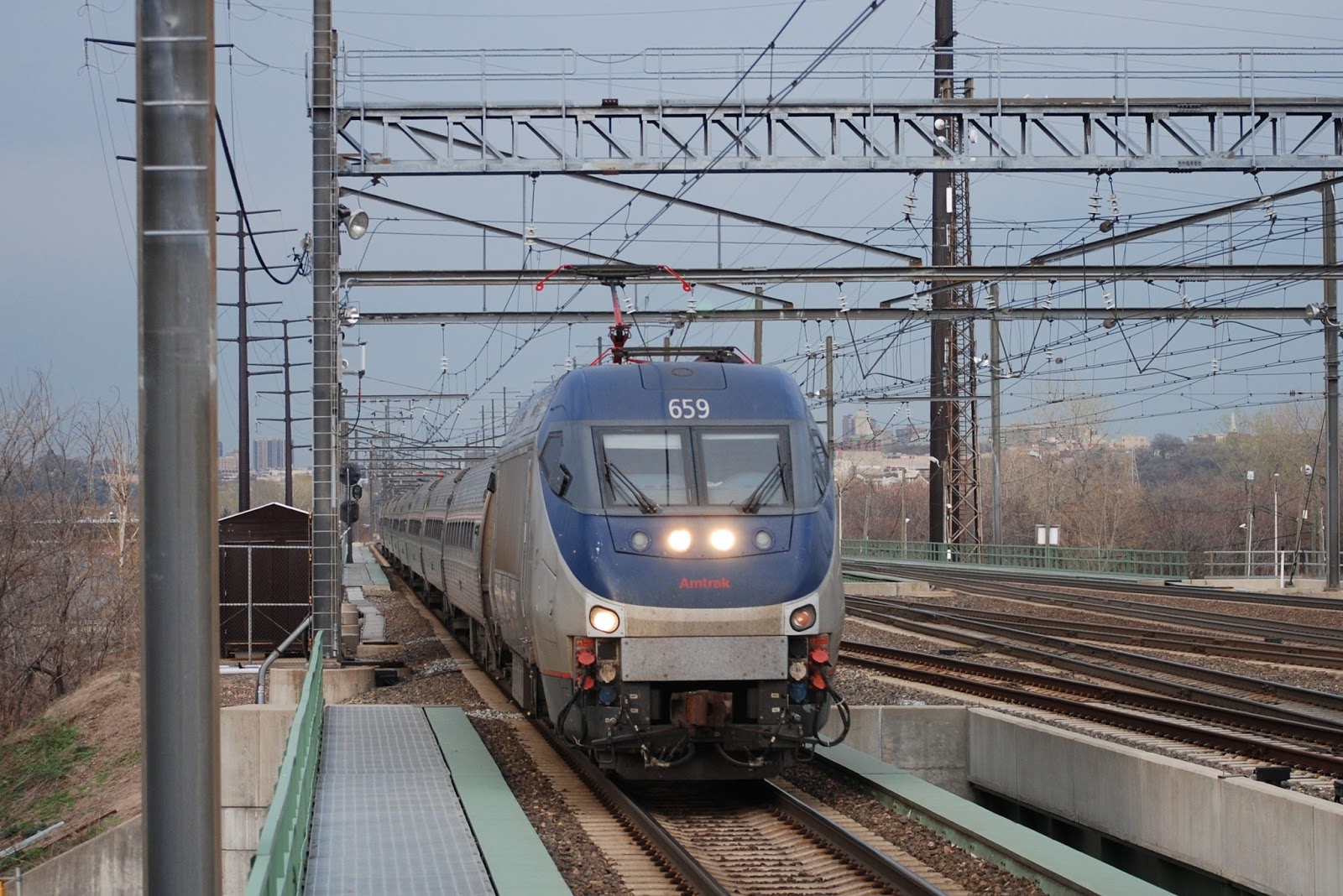 |
| The HHP-8 locomotives have been troublesome for Amtrak since their deliver and look set to have a somewhat short career on the North East Corridor. 659 leads a train of Amfleet coaches away from New York. |
All trains on the upper level are Electric as the lines go straight into Penn station which is barred to diesel locos. You will not even see Amtraks P42AC-DM locos (fitted with pick up shoes) at Secaucus- these work only on the 'Empire Corridor' out towards Albany- see my post here for details on these services.
Amtrak services do not stop at Secaucus.
When travelling do take note that at off-peak times coaches tend to get locked out of use... if you stand at the end of the platform when the train pulls in you may still have to run to the other end of the train!
 |
| In contrast the Swedish built AEM-7 locos have proved reliable workhorses. In the twilight of it's career 904 pushes an Amtrak service towards New York Penn. |
There is sadly not anywhere where you can successfully view trains on both the upper and lower levels- one has to take your pick and just accept that you will miss some things! I would recommend spending some time on both parts of the station- but there is a barrier line between them!
I had no difficulty or trouble standing on the platforms and taking photographs and judging from the quantity on the internet 'railfanning' should not be a problem. However as ever do not stray from public areas of the station, act suspiciously and be courteous and cooperative to staff should they approach you.
On a final note- this report is based on my trip to Secaucus in 2011 and I can therefore not guarantee that it is still up to date. Since it was written NJT have introduced bi-modal ALP-45DP (a bi-modal diesel/electric Traxx variation)- it is not known what impact these have had on the older diesel classes though I do not believe their delivery was intended to replace them.
 |
| The cream of the Amtrak fleet is the Acela Express. Powercar 2012 leads a train from Washington to Boston non-stop through Secaucus high level. |


 Immediately after leaving Penn Station the Amtrak trains take the 'Empire Connection' and then head along the west side of Manhattan. By the time the railway has passed under the George Washington Bridge, the line begins to open up a little. Continue further still to the tip of Manhattan and you reach Dykeman fields, a park right at the north western tip of Manhattan Island. The best way to reach the park is by subway taking the A train to 190th St and walking towards the Hudson river (I personally took the train to 181st St and went for a long walk beside the Hudson expressway!) Around half way down the park is a footbridge which offers good views of the line in both directions. The top photograph is taken from this location looking back towards Manhattan and shows 707 on an Empire service, typically with 5 Amfleet coaches. Walking right to the tip of the park allows a view across the swing bridge which takes the railway across the Harlem river from Manhattan into The Bronx. By aiming a camera through the fence the second photograph, showing 706, can be achieved of southbound trains.
 This location also has an added bonus that you can see the trains snaking alongside the Hudson River for some time as they approach, allowing photographs such as the third one on this page. Note that beyond the bridge the in The Bronx the Amtrak trains now travel on Metro-North rails, and their trains can also be seen.
 consists (in each direction) of an hourly EMU from Grand Central to Croton-Harman, and an hourly loco hauled service to Porkeepsie. There are several vantage points in this area which give a view across the Harlem river of the Metro-North line as shown in the fourth photograph. It is worth noting, as illustrated in the photograph, that the loco hauled Metro-North trains tend to pass at, or very close to this location resulting in a sudden burst of activity just once an hour!